lecture notes · 11 min read
Lecture Notes: How to Take, Organize, and Cite Them Properly
Master lecture notes from start to finish: effective note-taking methods, organizing systems, and how to cite lecture notes in APA and MLA formats.
Published November 15th, 2026 · Study Slay team

Lecture notes form the backbone of academic success, yet many students struggle with capturing information effectively, organizing it for later review, and citing it properly in academic work. This guide walks you through the complete lifecycle of lecture notes: how to take them efficiently during class, structure them for maximum retention, and reference them correctly in both APA and MLA citation styles.
Why Effective Lecture Notes Matter for Academic Success
Effective lecture notes serve as personalized study guides that bridge the gap between passive listening and active learning. When you write down concepts in your own words during a lecture, you engage with the material at a deeper cognitive level than simply reading it later from a textbook or reviewing generic resources.
Students who develop consistent note-taking habits report better recall during exams because the act of summarizing and structuring information creates stronger memory pathways. Your notes become a custom reference library tailored to exactly what your professor emphasizes, making exam preparation more targeted and efficient.
What Are the Best Methods for Taking Lecture Notes?
The best note-taking method depends on your learning style and the lecture format, but several proven systems help students capture information more effectively. The Cornell Method divides your page into three sections: a narrow left column for cues and questions, a wider right column for notes during the lecture, and a bottom summary section for review. This structure naturally prompts you to organize and condense information.
The Outline Method works well for hierarchical information, using indentation to show relationships between main ideas and supporting details. Mind mapping suits visual learners, placing the central topic in the middle and branching out with related concepts. The Sentence Method, where you write each new idea on a separate numbered line, offers speed during fast-paced lectures but requires more organization afterward.
How Does a Lecture Notes Taker Capture Information in Real Time?
A skilled lecture notes taker listens for signal phrases that indicate important information, such as "the key point is," "this will be on the exam," or "in summary." They capture main ideas rather than transcribing every word, using abbreviations and symbols to keep pace with the speaker while maintaining comprehension.
Effective note takers also leave space between concepts for later additions, mark areas of confusion with question marks to revisit after class, and use visual cues like stars or highlighting to flag especially important points. This active listening approach transforms note-taking from passive recording into an engaged learning process.
Should You Take Notes by Hand or Digitally?
Handwritten notes typically lead to better retention because the slower pace of writing forces you to process and summarize information rather than transcribe it verbatim. The physical act of writing also engages different cognitive pathways that strengthen memory formation.
Digital notes offer searchability, easier organization, and the ability to integrate multimedia elements like screenshots or audio clips. Tools designed for students can automatically transform lecture recordings into structured notes, saving time while ensuring you capture every detail. The ideal approach often combines both: handwritten notes during the lecture for better encoding, then digitized and enhanced with additional resources for review.

How to Organize Your Lecture Notes for Maximum Retention
Organizing lecture notes immediately after class significantly improves retention and makes exam preparation more efficient. Create a consistent filing system using folders or binders divided by course and date, and add descriptive headers to each set of notes that include the lecture topic, date, and key themes covered.
Review your notes within 24 hours while the lecture is still fresh, filling in gaps, clarifying unclear points, and adding examples or connections to other material. This review session transforms rough notes into a polished study resource and reinforces the material through spaced repetition.
What System Works Best for Organizing Notes Across Multiple Classes?
A topic-based organization system works best for most students, grouping notes by subject matter rather than strictly by date. Create separate sections for each course, then subdivide by unit or module, making it easy to locate specific concepts when preparing for exams or writing papers.
Digital organization adds another layer of efficiency through tags, search functions, and cross-references between related topics in different courses. A centralized platform that syncs across devices ensures you can access your notes whether you're studying in the library, at home, or on your commute.
How to Reference Lecture Notes in Academic Writing
Referencing lecture notes in academic writing acknowledges the source of ideas and allows readers to trace your reasoning. Lecture notes count as unpublished sources because they are not available to the general public, which affects how you cite them in different citation styles.
Always verify with your instructor whether they prefer you to cite lecture material directly or to find published sources that cover the same content. Some professors view lecture citations as appropriate acknowledgment of their intellectual contributions, while others encourage students to support arguments with peer-reviewed sources whenever possible.
How to Cite Lecture Notes in APA Format
To cite lecture notes in APA format, treat them as personal communications that appear only in in-text citations, not in your reference list. The in-text citation includes the instructor's name, the phrase "personal communication," and the exact date of the lecture in parentheses: (J. Smith, personal communication, October 15, 2023).
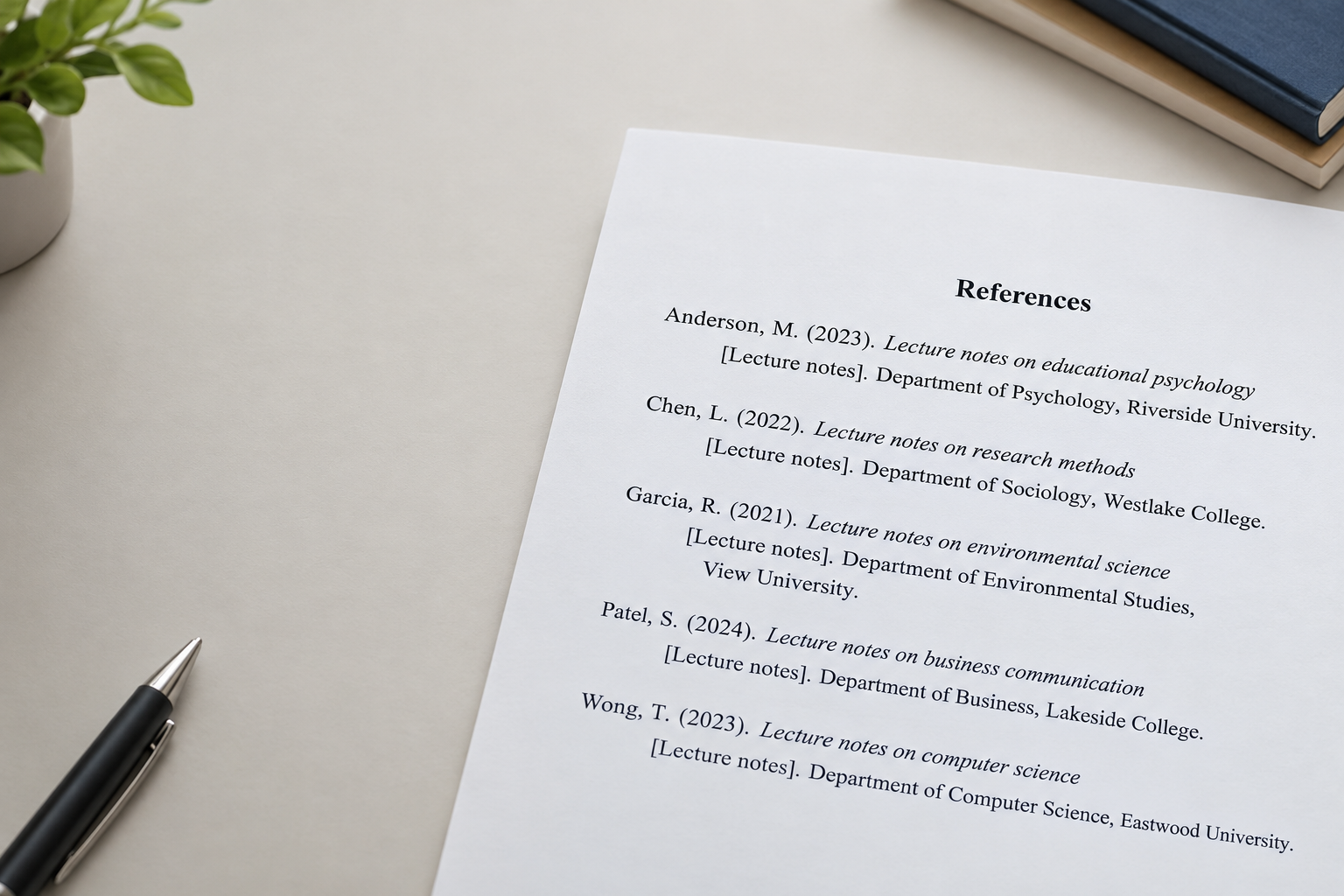
If the lecture materials are available to others, such as slides posted to a course website, treat them as retrievable data and include a full reference entry. List the instructor's name, the year, the title of the lecture in italics, the course name and number in brackets, and the institution name: Smith, J. (2023). Introduction to cognitive psychology [Lecture notes]. Department of Psychology, University of Example.
How to Cite Lecture Notes in MLA Format
MLA format treats lecture notes as live presentations, starting with the instructor's last name and first name, followed by the lecture title in quotation marks if given, or a description like "Lecture on molecular biology." Include the course name, institution, location, and date in day-month-year format: Smith, John. "The Structure of DNA." Biology 101, University of Example, Boston, 15 Oct. 2023. Lecture.
For lecture notes you accessed digitally through a course management system, add the platform name and URL after the lecture date: Smith, John. "The Structure of DNA." Biology 101, University of Example, 15 Oct. 2023. Canvas, canvas.university.edu/course/bio101.
Common Citation Mistakes to Avoid with Lecture Notes
The most common mistake students make when citing lecture notes is treating them like published books or articles, creating full reference entries when APA style requires personal communication format. Another frequent error involves citing "lecture notes" without specifying the instructor, date, or course, which makes it impossible for readers to understand the source.
Students also sometimes cite their own notes as sources, which is incorrect. You cite the original lecture or presentation, not your personal interpretation or summary of it. If you cannot remember whether an idea came from the lecture or from your own synthesis, revisit the original lecture materials or find a published source that covers the same concept.
Comparing Note-Taking and Citation Methods
| Method/Format | Best For | Key Feature |
|---|---|---|
| Cornell Method | Structured review and self-testing | Built-in cue column for questions |
| Outline Method | Hierarchical, logical subjects | Clear main idea and detail structure |
| Mind Mapping | Visual learners, brainstorming | Central topic with radiating branches |
| APA Citation | Social sciences, psychology, education | Personal communication in-text only |
| MLA Citation | Humanities, literature, arts | Full Works Cited entry for lectures |
How to Turn Raw Lecture Notes Into Study Materials
Transforming raw lecture notes into active study materials multiplies their value beyond simple review. Extract key terms and definitions to create flashcards, turn headings and subheadings into practice questions, and identify relationships between concepts that you can map visually.
Modern tools can automate much of this conversion process, instantly generating quizzes and flashcards from your lecture content. Platforms that transform lectures into AI notes analyze your material and create structured study guides, saving hours of manual work while ensuring comprehensive coverage of the lecture content.

What Role Do Flashcards Play in Reviewing Lecture Notes?
Flashcards transform passive review into active retrieval practice, forcing you to recall information rather than simply recognizing it. When you convert lecture notes into flashcards, you break complex material into digestible chunks and create a personalized testing system that identifies weak spots in your understanding.
The most effective flashcards ask for explanations and applications rather than simple definitions. Instead of "What is photosynthesis?" try "Explain how light-dependent and light-independent reactions work together in photosynthesis." This deeper questioning mirrors exam formats and builds genuine comprehension. Tools that automatically generate flashcards from your notes can speed up this process while maintaining the quality of your study materials.
How to Reference Lecture Notes You Did Not Personally Attend
When citing lecture notes you obtained secondhand, such as notes shared by a classmate or posted online by someone other than the instructor, cite the original lecture, not the notes themselves. Your citation should reference the instructor who delivered the lecture, the lecture title or topic, and the date it occurred, even if you accessed the information through someone else's notes.
If you only have access to another student's interpretation and cannot verify the original lecture details, it is better to find a published source that covers the same material rather than citing information you cannot authenticate. Academic integrity requires that you trace ideas to their original source whenever possible.
Lecture Notes FAQs
How do I cite lecture notes in APA if the instructor posted them online?
If the instructor posted lecture notes online where other students can access them, cite them as retrievable course materials rather than personal communication. Include the instructor's name, year, lecture title in italics, course information in brackets, institution name, and the URL if publicly accessible. Format: Instructor, A. (Year). Lecture title [Lecture notes]. Department Name, Institution Name. URL
Should I cite my own lecture notes in a research paper?
No, you should cite the original lecture or presentation, not your personal notes. Your notes are your interpretation and summary of the lecture content, but the ideas originated with the instructor. Cite the instructor's lecture using the appropriate format for your citation style, acknowledging them as the source of the concepts.
What is the difference between citing a lecture and citing lecture notes?
The difference lies in whether the material is retrievable by others. A live lecture you attended in person is typically cited as personal communication in APA or as a lecture in MLA. Lecture notes that are published or posted where others can access them are cited as retrievable sources with full reference entries. The key factor is public accessibility, not the format of the material.
How can I improve my note-taking speed during fast-paced lectures?
Develop a personal shorthand system using abbreviations for common terms in your field, symbols for relationships (arrows for "leads to," equal signs for "is defined as"), and acronyms for frequently mentioned concepts. Focus on capturing main ideas and supporting points rather than complete sentences. Leave gaps to fill in later, and consider recording lectures (with permission) so you can revisit sections you missed while maintaining your listening focus during class.
Are handwritten or digital lecture notes more effective for studying?
Handwritten notes generally produce better initial retention because writing by hand is slower, forcing you to process and summarize information actively. However, digital notes offer superior organization, searchability, and the ability to enhance them with multimedia. The most effective approach combines both: write by hand during lectures to boost encoding, then organize and supplement digitally for long-term study and review.
Building a Sustainable Note-Taking System
Creating a note-taking system that works across all your courses requires consistency, regular review, and the right tools. Establish a routine where you review and organize notes within 24 hours of each lecture, add visual elements or examples to clarify complex points, and connect new information to material from previous lectures or other courses.
Your note-taking system should grow with you throughout your academic career. What works for introductory courses may need adjustment as you move into advanced seminars or lab-based classes. Periodically evaluate whether your current method captures information efficiently, supports your study habits, and integrates well with how you prepare for exams. Tools like Study Slay adapt to various lecture formats and learning styles, automatically converting recordings and documents into organized, searchable notes that sync across all your devices.
The ability to chat with your notes adds another dimension to review, letting you ask questions and test your understanding interactively. This transforms static notes into a dynamic study partner that responds to your specific learning needs.
Mastering lecture notes requires intentional practice in capturing, organizing, and citing information properly. The methods you choose matter less than your consistency in applying them and your willingness to refine your approach based on what produces the best results. Whether you prefer the Cornell Method, mind mapping, or digital tools that automate much of the process, the goal remains the same: transform lectures into personalized study materials that support long-term retention and academic success. Start by implementing one new strategy from this guide in your next lecture, then build from there as you discover what works best for your learning style and course demands. For students looking to turn lecture recordings into structured notes, modern platforms can significantly reduce the time investment while improving the quality and organization of your study materials.