study ai · 13 min read
What Is Study AI and How Can It Transform Your Learning?
Discover what study AI is, how it works for students, and which platforms offer the best free tools to accelerate your learning in math, science, and more.
Published October 24th, 2026 · Study Slay team
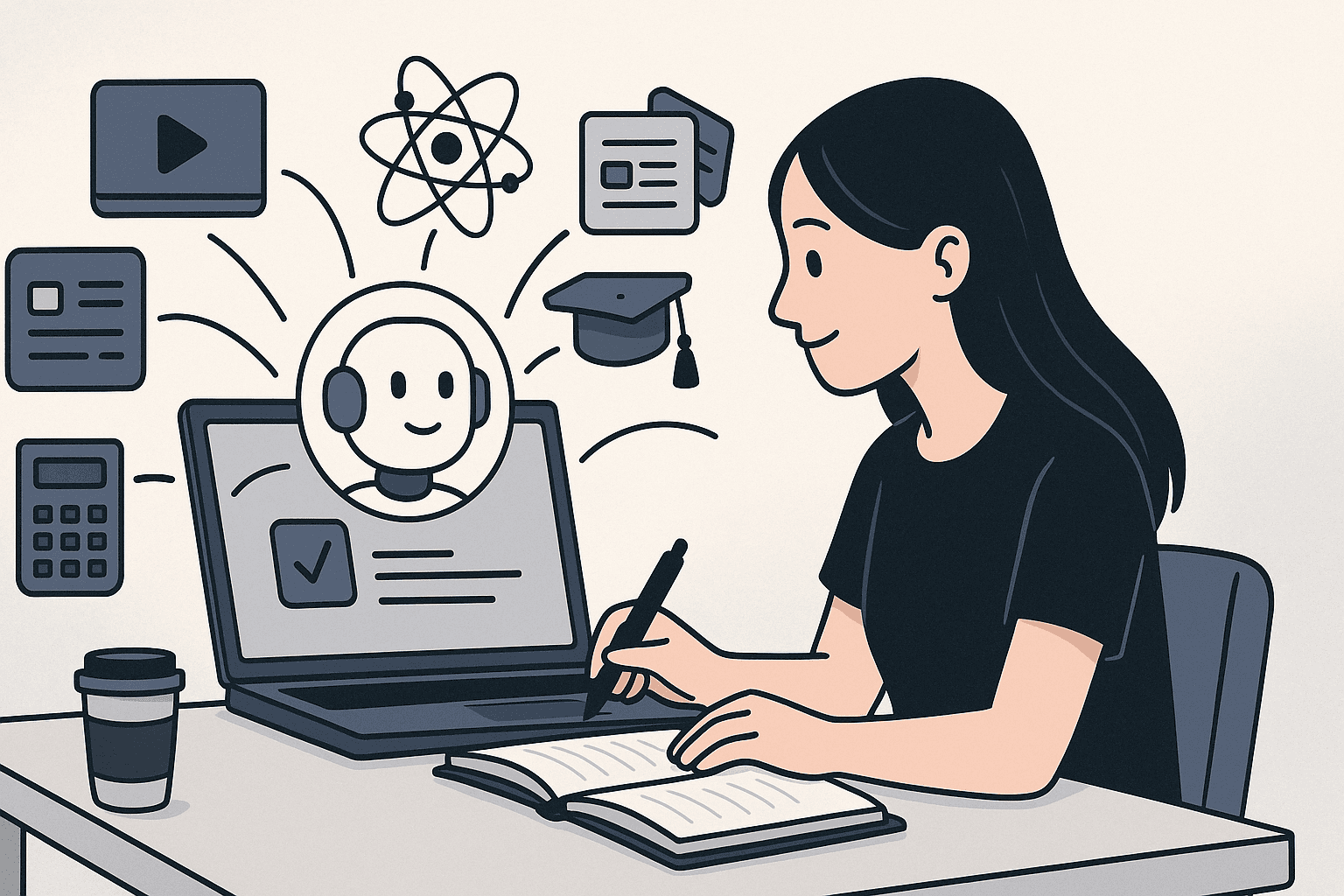
Study AI refers to artificial intelligence systems designed specifically to help students learn more effectively by automating note-taking, generating quizzes and flashcards, and providing personalized tutoring through conversational interfaces. These platforms analyze your lecture recordings, PDFs, and study materials to create structured learning resources that adapt to your pace and comprehension level.
The shift from traditional study methods to AI-powered learning tools represents one of the most significant changes in education technology. Students no longer need to spend hours manually transcribing lectures or creating flashcards by hand. Instead, study AI platforms handle the repetitive work while you focus on actual learning and retention.
What Exactly Is Study AI?
Study AI is a category of educational technology that uses machine learning algorithms to transform raw educational content into active learning materials. The technology processes various input formats—audio recordings of lectures, PDF textbooks, YouTube videos, or even handwritten notes—and converts them into organized notes, interactive quizzes, and spaced-repetition flashcards without manual effort.
The core mechanism behind these tools involves natural language processing that identifies key concepts, definitions, relationships between ideas, and important facts within your study materials. Once the AI understands the content structure, it generates study aids that align with proven learning science principles like active recall and spaced repetition.
How Does Study AI Work for Students?
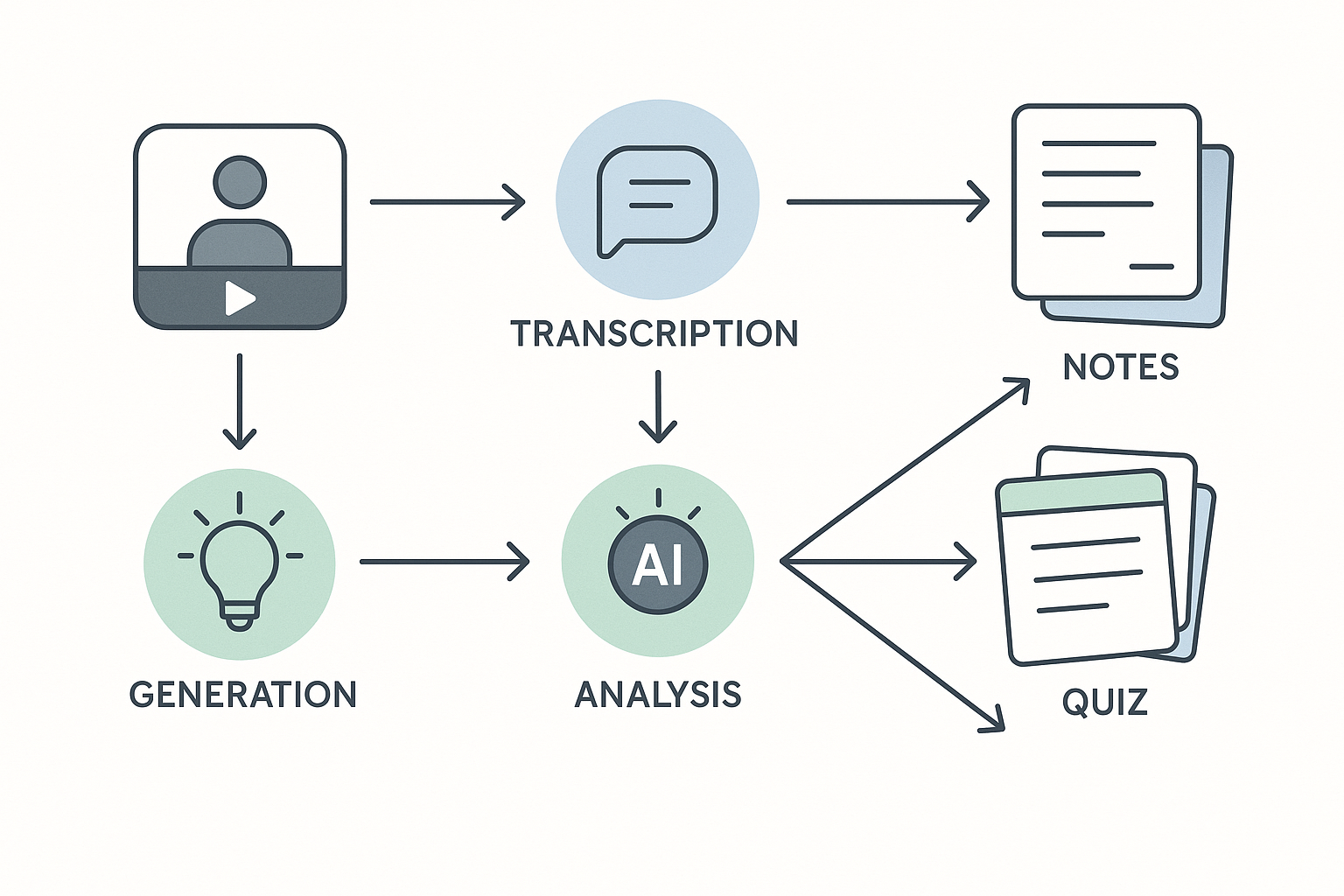
Study AI for students operates through a multi-step process that begins with content ingestion. When you upload a lecture recording or PDF chapter, the system first transcribes any audio, then analyzes the text to identify the hierarchical structure of concepts, from main topics down to supporting details and examples.
After analysis, the AI generates multiple study formats from the same source material. A single hour-long biology lecture becomes a structured outline, a set of 20-30 flashcards covering key terms, and a practice quiz testing comprehension, all created automatically. This transformation happens in minutes rather than the hours it would take to manually create the same resources.
What Are the Core Components of Study AI Platforms?
The core components include transcription engines that convert spoken lectures to text, natural language understanding models that extract key information, and generation algorithms that create questions and flashcards. Most platforms also integrate chat interfaces that let you ask questions about your materials and receive instant explanations, functioning as an on-demand tutor that knows your specific course content.
Google Study AI: What Options Does Google Offer?
Google study AI primarily refers to Google's experimental AI features in products like NotebookLM, which allows students to upload documents and interact with them through a conversational AI interface. The tool generates summaries, answers questions about uploaded content, and helps students synthesize information across multiple sources.
While Google's tools excel at document analysis and question-answering, they function differently from dedicated study platforms that are purpose-built for creating flashcards and quiz materials. Google's approach focuses more on research assistance and comprehension, whereas specialized study AI emphasizes active recall and spaced repetition for exam preparation.
Understanding Unstuck Study AI Features
Unstuck study AI refers to features that help students move past learning roadblocks by providing targeted explanations when they're confused. These systems detect when you repeatedly miss the same type of question or struggle with a particular concept, then automatically provide additional context, alternative explanations, or simpler prerequisite material.
The practical value emerges when you're studying alone at midnight before an exam and encounter a concept you don't understand. Instead of searching through your textbook or waiting for office hours, you can ask the AI chat feature for an explanation tailored to your current level of understanding, with examples drawn directly from your course materials.
How Does AI Detect When You're Stuck?
AI detects learning obstacles through pattern recognition in your quiz and flashcard performance. When you mark the same flashcard as difficult multiple times, or consistently answer questions about a specific topic incorrectly, the system flags that concept for additional reinforcement and automatically surfaces related explanations or breaks the concept into smaller chunks.
What Is Thea Study AI?
Thea study AI represents a subcategory of personalized AI tutoring systems that adapt their teaching approach based on individual learning patterns. These systems track which study methods work best for you over time and adjust the difficulty, frequency, and format of practice questions accordingly.
The adaptive element means the platform doesn't just generate static flashcards. Instead, it monitors which cards you find easy versus challenging, then schedules reviews at optimal intervals based on your personal retention curve. Cards you struggle with appear more frequently until you demonstrate mastery, while concepts you've mastered get pushed to longer review intervals.
How to Study AI: Getting Started with AI Study Tools
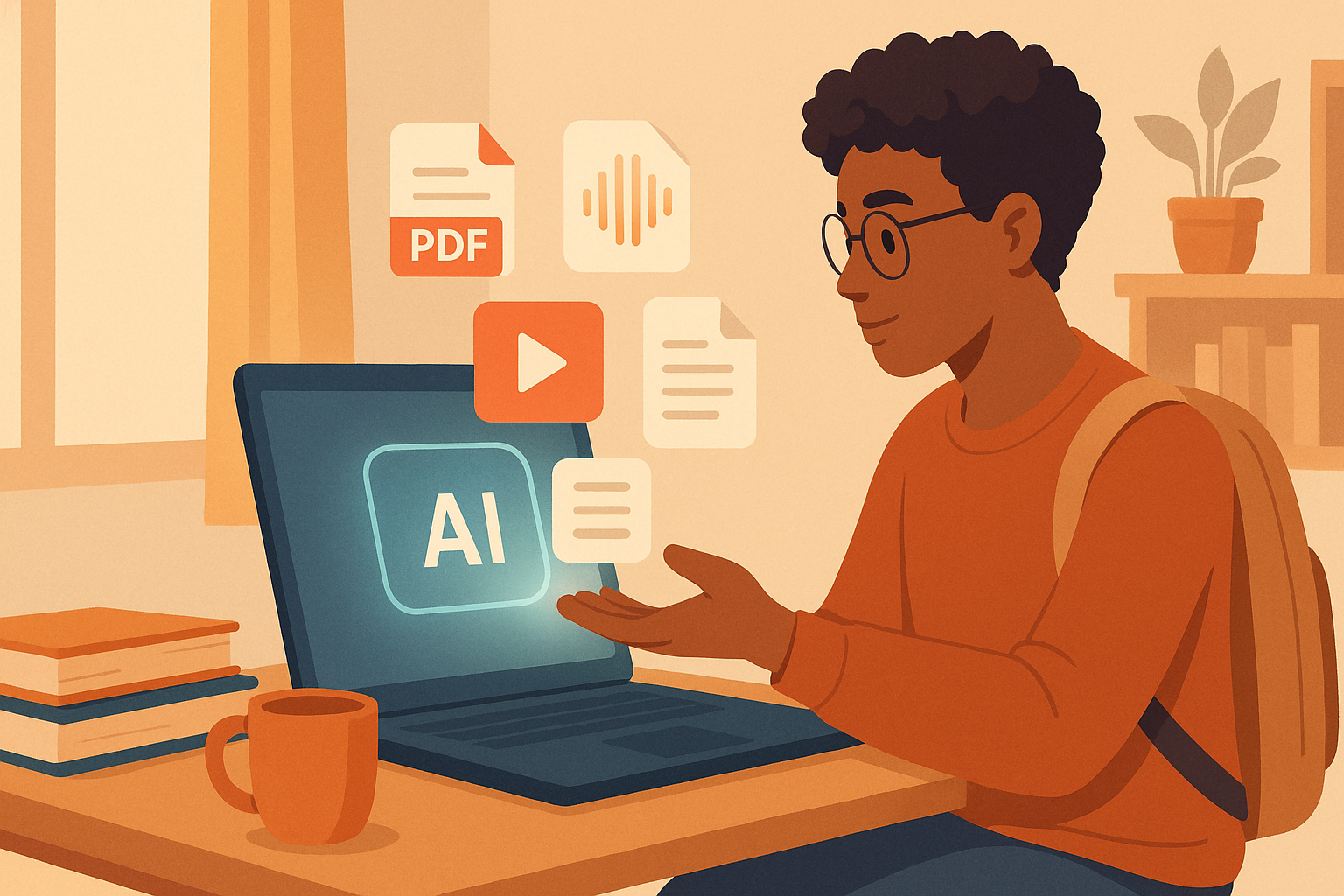
Getting started with AI study tools requires uploading your course materials in whatever format you have them, whether that's lecture recordings, PDF textbooks, slides, or YouTube video links. Most platforms accept multiple formats, so you can combine different sources from the same class into one organized study space.
After uploading, review the automatically generated notes to ensure the AI captured the main concepts correctly. While these systems are accurate, they sometimes miss context-specific information that was delivered verbally but not explicitly stated. Once you verify the notes are complete, you can immediately begin studying from the generated flashcards and quizzes rather than spending time creating them manually.
What File Formats Work Best with Study AI?
Audio files in MP3 or M4A format work best for lecture recordings, while PDFs are ideal for textbooks and slides. Video files from Zoom recordings or YouTube links are also widely supported, as the AI can extract audio, transcribe it, and ignore visual elements that don't contribute to content understanding.
| Input Format | Processing Time | Best Use Case |
|---|---|---|
| Audio recording | 2-5 minutes | Lecture captures and voice memos |
| PDF document | 1-3 minutes | Textbook chapters and slides |
| YouTube video | 3-6 minutes | Supplemental tutorials and lectures |
| Text document | Under 1 minute | Notes and reading assignments |
Math Study AI: How AI Handles STEM Subjects
Math study AI tackles the unique challenge of processing equations, formulas, and step-by-step problem solving, which standard text processing can't handle effectively. These specialized systems use computer vision to recognize mathematical notation in PDFs and handwritten notes, then convert it into a format the AI can work with.
For math-heavy courses like calculus, linear algebra, or physics, the AI doesn't just extract formulas. It can generate practice problems with similar structure to your examples, provide step-by-step solutions when you're stuck, and create flashcards that test your understanding of when to apply specific formulas rather than just memorizing them.
Can Study AI Show Step-by-Step Math Solutions?
Yes, advanced study AI platforms can show step-by-step math solutions by breaking down problems into individual operations and explaining the reasoning behind each step. When you ask about a specific problem or formula, the AI identifies the problem type, applies the appropriate solution method, and annotates each transformation so you understand the logical progression rather than just seeing the final answer.
Best Free Study AI Tools Available Now
The best free study AI tools offer core features like transcription, note generation, and basic flashcard creation without charging for essential functionality. Platforms typically provide free tiers that allow you to upload a limited number of documents per month or restrict advanced features like unlimited AI chat, but still deliver substantial value for students on a budget.
When evaluating free options, prioritize platforms that don't watermark your notes or lock you into proprietary formats. The ability to export your generated flashcards and notes ensures you're building a study resource library you can access even if you change platforms later. Look for tools that let you generate AI notes from lectures and documents with minimal restrictions on the free tier.
MIT Study AI Jobs and Academic Research
MIT study AI jobs encompass research positions and industry roles focused on developing next-generation educational AI systems, improving learning algorithms, and studying how students interact with AI tutoring platforms. These positions sit at the intersection of machine learning, cognitive science, and education research.
The academic research coming from institutions like MIT informs how commercial study AI platforms are built. Studies on spacing effects, retrieval practice, and adaptive learning all originated in cognitive psychology labs and now form the foundation of how AI schedules flashcard reviews and generates practice questions.
Key Features to Look for in Study AI Platforms
Essential features include multi-format input support, accurate transcription for lectures, automatic flashcard generation based on your content, and spaced repetition scheduling that adapts to your performance. Platforms should also offer cross-device sync so you can study on your laptop during deep study sessions and review flashcards on your phone during commutes.
Advanced features that significantly enhance learning include AI chat that answers questions about your specific materials, the ability to generate practice quizzes automatically, and annotation tools that let you mark up PDFs while the AI incorporates your highlights into generated study materials. Integration with your existing workflow matters too: look for platforms that work with Google Drive, Notion, or whatever system you already use.
What Makes AI Flashcards More Effective Than Manual Ones?
AI flashcards are more effective because they're created faster, covering more material in less time, and they're automatically scheduled using spaced repetition algorithms that time reviews at optimal intervals for long-term retention. Manual flashcard creation is time-consuming, often leading students to create fewer cards that cover less material, while AI can generate comprehensive coverage of an entire lecture in minutes.
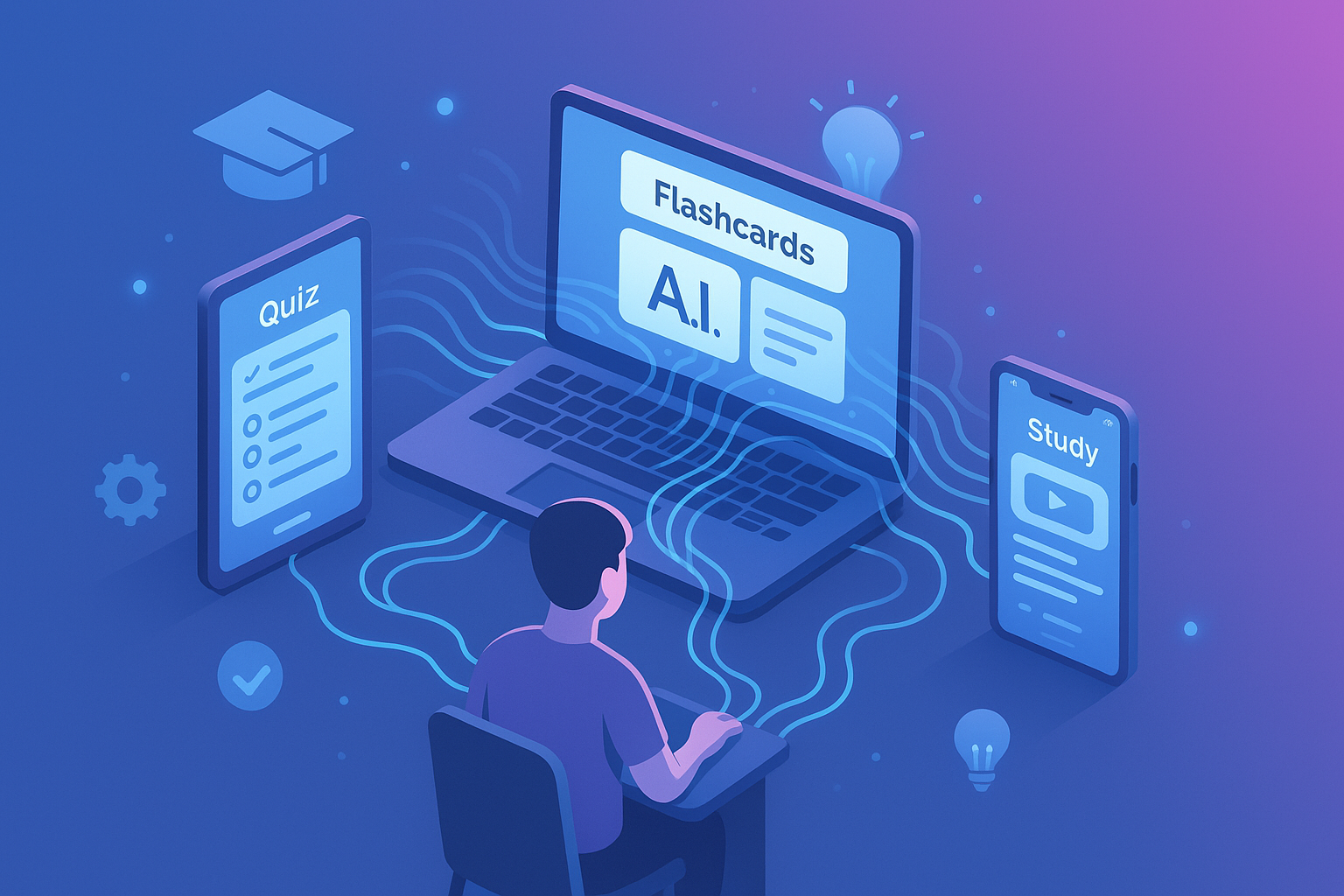
Integrating Study AI into Your Daily Routine
Integrating study AI into your daily routine starts with uploading course materials immediately after each lecture, rather than waiting until exam week. This approach builds your study library progressively throughout the semester, so when midterms arrive, you already have weeks of organized notes and flashcards ready for review.
Set a daily review habit where you spend 15-20 minutes going through scheduled flashcard reviews each morning or evening. The AI will surface exactly the cards you need to review that day based on spacing algorithms, so you're not wasting time on material you already know well. This consistent, distributed practice is far more effective than cramming sessions before exams.
How Much Time Does Study AI Actually Save?
Study AI typically saves students three to five hours per week that would otherwise be spent on manual note organization, flashcard creation, and searching through materials for key information. A one-hour lecture that might take 90 minutes to manually transcribe and another hour to convert into flashcards can be processed by AI in under five minutes, with comparable or better quality in the resulting study materials.
Common Limitations of Current Study AI Technology
Current study AI technology struggles with highly visual subjects where understanding depends on diagrams, charts, or physical demonstrations that can't be captured through text alone. While the AI can transcribe what a professor says about a diagram, it may miss the spatial relationships and visual patterns that make the concept clear.
Another limitation is context understanding in specialized fields with domain-specific terminology. The AI might misinterpret technical jargon or miss subtle distinctions between similar concepts if the training data didn't include enough examples from that specific field. This is improving rapidly as models are exposed to more academic content, but it means you should always review AI-generated materials for accuracy before relying on them for exam prep.
Privacy and Data Security in Study AI
Privacy in study AI platforms centers on how your uploaded course materials and study data are stored, processed, and potentially used to train AI models. Reputable platforms clearly state whether your content remains private or is used for model improvement, and they should offer options to delete your data permanently.
For students uploading sensitive materials like research notes or proprietary course content, verify that the platform uses encryption for data in transit and at rest. Check whether the service shares data with third parties and whether you retain intellectual property rights to both your original uploads and the AI-generated study materials.
Frequently Asked Questions About Study AI
Can study AI work with handwritten notes?
Study AI can work with handwritten notes if you scan or photograph them clearly, though accuracy depends on handwriting legibility. The AI uses optical character recognition to convert handwriting to text, then processes it the same way as typed content, but messy handwriting or poor image quality will reduce the accuracy of generated study materials.
Is using study AI considered cheating?
Using study AI is not considered cheating because it's a study tool that helps you learn material more efficiently, similar to using a textbook or tutor. The AI doesn't complete assignments for you or provide answers during exams; it creates study resources from your own course materials to help you master the content through active learning techniques.
How accurate are AI-generated flashcards?
AI-generated flashcards are typically accurate for factual information, definitions, and straightforward concepts, with accuracy rates generally above 90 percent for clear source material. However, you should review them for context-specific nuances or interpretations that might differ from how your professor frames concepts, and edit any cards that don't perfectly match your course's specific terminology.
Can I use study AI for multiple classes simultaneously?
Yes, you can use study AI for multiple classes simultaneously by creating separate study spaces or folders for each course, keeping materials organized and preventing confusion between subjects. Most platforms like Study Slay allow unlimited courses on their platform, so you can manage all your classes in one place while keeping each course's materials isolated.
What happens if the AI makes a mistake in my notes?
If the AI makes a mistake in your notes, you can manually edit the generated content to correct errors, and most platforms save your edits so the corrected version is what appears in your flashcards and quizzes. This editing capability means you get the time savings of automatic generation while maintaining the accuracy of reviewed, human-verified content.
Taking Your Learning Further with AI Study Tools
The transformation study AI brings to learning goes beyond simple automation. It fundamentally changes how you engage with course material by removing the tedious parts of studying and freeing your cognitive energy for actual comprehension and synthesis. When you're not spending hours creating flashcards, you can spend that time practicing retrieval, connecting concepts across subjects, or engaging with AI chat to deepen understanding of difficult topics.
Students who adopt these tools early in their academic careers develop more sophisticated study habits because the AI handles the organizational structure while they focus on learning strategies. This means you can experiment with different review schedules, test various active recall techniques, and identify which study methods work best for your learning style, all supported by technology that adapts to your needs.
Getting started requires only uploading your first lecture or PDF chapter to see how the technology transforms raw materials into structured study resources. Most platforms offer automatic flashcard generation and note-taking features that work immediately without a learning curve, so you can begin experiencing the benefits in your next study session. The shift from passive reading and manual note organization to AI-augmented active learning represents not just a productivity gain, but a qualitatively different and more effective approach to mastering academic content.