flashcards · 13 min read
Flashcards for Studying: Complete Guide to Better Retention
Master the science of flashcards for studying with proven methods, spaced repetition strategies, and platform comparisons to boost memory retention and exam scores.
Published November 2nd, 2026 · Study Slay team

Flashcards for studying remain one of the most effective learning tools available, backed by decades of cognitive science research showing they strengthen memory retention through active recall and spaced repetition. This guide walks you through the fundamental principles, platform options, and evidence-based strategies that transform simple card-based review into a systematic approach to mastering any subject.
How Do Flashcards Improve Memory Retention?
Flashcards work by triggering active recall, the process of pulling information from memory without prompts or cues, which creates stronger neural pathways than passive review methods like rereading notes. Each time you attempt to answer a flashcard question before flipping to the answer, your brain engages in effortful retrieval that consolidates the memory trace and makes future recall faster and more reliable.
The mechanism goes beyond simple memorization. When you test yourself with flashcards, your brain must reconstruct the information from memory, a process that identifies gaps in understanding and signals which concepts need more attention. This feedback loop helps you allocate study time efficiently, focusing on material you haven't mastered rather than reviewing content you already know.
What Makes a Good Flashcard for Studying?
A well-designed flashcard focuses on one discrete piece of information or concept, avoiding the common mistake of cramming multiple facts onto a single card. When you keep each card atomic, you can accurately assess whether you know that specific fact, and your brain can form a clear, unambiguous memory link between the question and answer.
Effective flashcards use clear, specific prompts that trigger the exact knowledge you need. Vague questions like "Tell me about photosynthesis" yield vague answers, while "What are the three products of the light-dependent reactions in photosynthesis?" demands precision. Your prompt should be written the way an exam question would be phrased, so practicing with the card directly prepares you for the actual test format.
Context clues improve retention for complex topics. Adding a brief hint, category label, or example to your prompt helps your brain file the information in the right mental folder, making retrieval easier when you encounter related questions later. For instance, a multiplication facts flashcard showing "7 × 8" benefits from a consistent visual layout that helps pattern recognition alongside memorization.
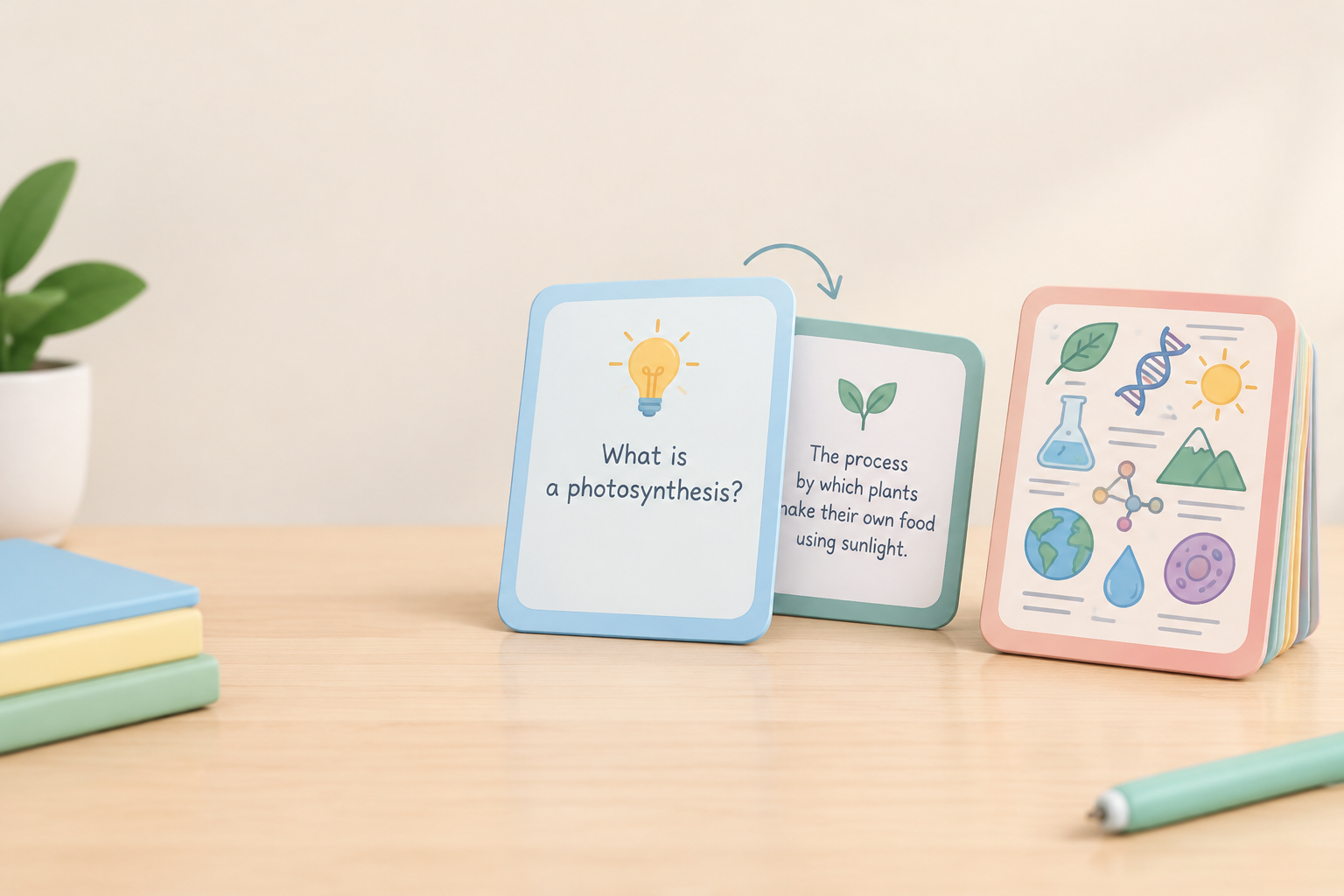
Digital vs. Paper Flashcards: Which Format Works Better?
Digital flashcards automate spaced repetition scheduling, track performance data, and sync across devices, making them the practical choice for students managing large volumes of material across multiple subjects. Platforms calculate optimal review intervals based on how well you know each card, eliminating the manual sorting and scheduling required with paper decks.
Paper flashcards offer tactile engagement and freedom from screen fatigue, benefits that matter most for shorter study sessions or when learning content that benefits from handwriting, such as sight word flashcards for early readers or quick vocabulary drills. The physical act of writing cards by hand can deepen initial encoding, though the advantage disappears during long-term review where digital automation shines.
The best choice depends on your material volume and study timeline. For comprehensive exam preparation covering hundreds of concepts, digital tools handle the complexity better. For focused mastery of a small set, such as multiplication table flashcards for a single operation family, paper cards work perfectly well and cost nothing.
Spaced Repetition: The Science Behind Effective Review
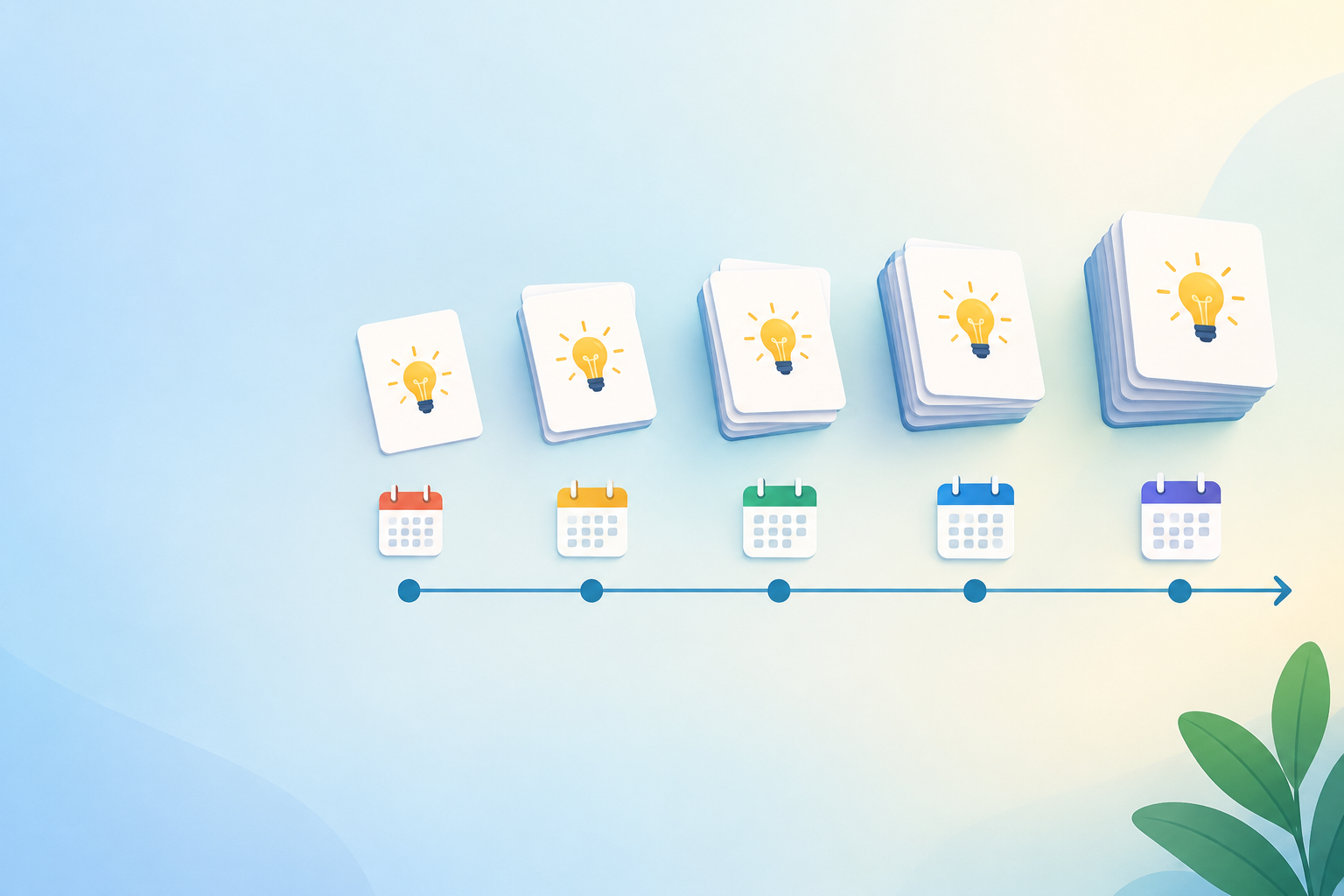
Spaced repetition schedules reviews at increasing intervals, counteracting the forgetting curve by refreshing memories just before they would fade. Instead of cramming all reviews into one session, you review new material after one day, then three days, then a week, then two weeks, with each successful recall pushing the next review further into the future.
This timing exploits a quirk of human memory: retrieval becomes more effortful as time passes, and that increased effort during successful recall strengthens the memory more than easy, immediate review does. When you struggle slightly to remember an answer and then succeed, the memory trace becomes more durable than if you had reviewed the same card ten times in quick succession.
Most digital flashcard platforms build spaced repetition algorithms into their core functionality, automatically scheduling cards based on your performance. Study Slay generates flashcards from your lecture notes and PDFs, then applies spaced repetition scheduling so you can focus on learning rather than manually organizing review sessions.
How Often Should You Review Flashcards?
You should review flashcards daily during the initial learning phase, completing all cards due that day according to your spaced repetition schedule, which typically takes 15 to 30 minutes per subject. Once the algorithm pushes cards to longer intervals, your daily review load shrinks as more material shifts into long-term memory with review dates weeks or months away.
Consistency matters more than duration. A 20-minute daily session outperforms a single three-hour weekend cramming session because distributed practice gives your brain time to consolidate memories between reviews, a process that happens during sleep and downtime.
Popular Flashcard Platforms Compared
Several established platforms dominate the digital flashcard space, each with distinct features and trade-offs that suit different student needs and learning contexts. Understanding the core differences helps you choose the tool that matches your workload, tech comfort, and study goals.
| Platform | Best For | Key Feature | Learning Curve |
|---|---|---|---|
| Quizlet flashcards | Beginners, shared decks | Large library of pre-made sets | Very low |
| Anki flashcards | Advanced users, medical/law students | Powerful customization, add-ons | Steep |
| AnkiDroid flashcards | Android users on budget | Free, full Anki compatibility | Moderate |
| AnkiApp flashcards | Mobile-first learners | Simplified interface | Low |
| Study Slay | Auto-generation from lectures, PDFs | AI-powered card creation | Very low |
What Are the Limitations of Pre-Made Flashcard Decks?
Pre-made flashcard decks often miss the specific terminology, examples, and emphasis your instructor uses, creating a mismatch between what you review and what appears on your exam. When you study cards designed for a generic course instead of your actual syllabus, you waste time on content that won't be tested and miss concepts your professor highlighted.
Creating your own cards forces you to process the material during card creation, an encoding step that pre-made decks skip entirely. That initial engagement with the content when you decide what to put on each card contributes to learning before you even begin review sessions. Tools like Study Slay's flashcard generator bridge this gap by creating cards directly from your lecture notes and course PDFs, ensuring alignment with your actual coursework while automating the card creation process.
Creating Effective Flashcards from Lecture Notes
Start by identifying key concepts, definitions, and relationships in your notes rather than copying entire paragraphs onto cards. Look for information that can be tested with a clear question and answer pair: vocabulary terms, cause-and-effect relationships, formulas, classifications, and step-by-step processes all translate well to flashcard format.
Transform statements into questions by inverting the structure. If your notes say "Mitochondria produce ATP through cellular respiration," create a card asking "Which organelle produces ATP through cellular respiration?" and another asking "What process do mitochondria use to produce ATP?" This dual-direction approach tests both recognition and recall from different angles.
Platforms that automate this conversion save hours of manual work. When you upload lecture recordings or PDF textbooks to Study Slay's AI notes feature, the system extracts key concepts and generates flashcards automatically, letting you review and refine the deck rather than building it from scratch.
How Should You Approach Difficult Cards?
When you consistently get a card wrong, break it into smaller sub-cards that test individual components of the concept separately. A complex card asking you to explain an entire biological pathway might need to become five cards, each testing one step, so you can pinpoint exactly which part you don't understand.
Add memory aids directly to the card: mnemonics, vivid mental images, or connections to concepts you already know well. If you're struggling with a particular sight word flashcard, for example, adding a sentence that uses the word in context gives your brain an additional retrieval cue beyond the isolated word itself.
Review the source material for difficult cards instead of just drilling the card repeatedly. Sometimes the card itself is fine, but you lack the foundational understanding needed to remember the answer, and returning to your notes or textbook to rebuild that foundation solves the problem permanently.
When Should You Delete or Retire a Flashcard?
Delete flashcards that test trivial details unlikely to appear on exams, redundant cards that overlap too much with others in your deck, or poorly worded cards that confuse you more than they help. A bloated deck full of low-value cards wastes review time and dilutes your focus on material that actually matters for your grade.
Retire cards you've mastered completely and reviewed successfully at long intervals multiple times, especially after the exam they were created for has passed. Keeping ancient cards in active rotation clutters your daily reviews, though you might archive them rather than delete them outright in case you need to review the topic for a cumulative final.

Subject-Specific Flashcard Strategies
Different subjects demand different flashcard approaches, and adapting your card design to the material type improves both efficiency and retention.
How Do You Use Flashcards for Math and Formulas?
Math flashcards should test both formula recall and application in realistic problem scenarios, not just rote memorization of equations. Create one card asking for the formula itself, then separate cards presenting sample problems that require using that formula, so you practice recognizing when to apply each tool.
For multiplication facts flashcards or flashcards times tables, randomize the order rigorously to prevent pattern memorization, where students remember position in the deck rather than the actual math fact. Digital platforms shuffle automatically, eliminating this common paper-flashcard pitfall.
What Works Best for Language and Vocabulary?
Language flashcards benefit from bidirectional cards, testing both translation from your native language to the target language and reverse translation back. Most platforms let you enable reverse cards automatically, doubling your practice without doubling card creation time.
Include pronunciation guides, example sentences, and gender markers directly on vocabulary cards, turning each card into a complete reference rather than a bare word pair. This extra context improves retention and helps you use the word correctly in conversation, not just recognize it in isolation.
Combining Flashcards with Other Study Methods
Flashcards excel at memorization and recall but should complement, not replace, deeper study methods like practice problems, essay writing, and concept mapping. Use flashcards to lock in foundational facts and terminology first, then apply that knowledge through problem sets or practice essays that test higher-order thinking.
The sequence matters: flashcard review works best after you've initially learned the material through reading or lecture, not as your first exposure to new content. Read the chapter or watch the lecture, then create and review flashcards to reinforce what you just learned, cycling between comprehension and memorization rather than trying to memorize before you understand.
Integrate quizzes and practice tests into your routine alongside flashcard review. While flashcards test individual facts, full-length practice tests simulate exam conditions and reveal how well you can synthesize multiple concepts under time pressure. Study Slay's quiz feature generates practice questions from the same material as your flashcards, giving you both memorization and application practice in one ecosystem.
Common Flashcard Mistakes to Avoid
The biggest mistake students make with flashcards is marking a card correct when they only partially recalled the answer or needed to peek. Honest self-assessment drives the spaced repetition algorithm; if you mark difficult cards as correct, they disappear from review before you've actually mastered them, only to resurface as gaps on exam day.
Creating cards too late in the study cycle undermines the spaced repetition benefit. If you wait until two weeks before the exam to make flashcards, you don't have enough time for multiple spaced reviews, reducing flashcards to a glorified cramming tool. Build your deck as you go through the course, adding cards after each lecture or reading assignment.
Passive reading of flashcards without genuine retrieval effort defeats the purpose entirely. Always try to recall the answer before flipping the card, even if you draw a complete blank. That moment of effortful retrieval, successful or not, is what builds memory, while simply reading question and answer together teaches you nothing.
Frequently Asked Questions
How many flashcards should I study per day?
You should study between 20 and 50 new flashcards per day depending on the complexity of your material and your available study time, plus all cards due for review according to your spaced repetition schedule. Most students find this volume sustainable without burnout, though you can adjust based on how long reviews take and how well you're retaining information.
Can flashcards replace reading the textbook?
Flashcards cannot replace textbook reading because they test memorization of facts rather than building the deep conceptual understanding that reading provides. Use textbooks to learn and understand concepts first, then create flashcards to memorize key details, definitions, and relationships you need to recall quickly during exams.
What is the best time of day to review flashcards?
The best time to review flashcards is whenever you can maintain consistent daily practice, though many students find morning sessions effective because the brain is fresh and memory consolidation from sleep is complete. Short review sessions distributed throughout the day, during commutes or breaks, also work well and may improve retention compared to a single long session.
How long does it take to see results from flashcard studying?
Most students notice improved recall within one to two weeks of consistent daily flashcard review, with the full benefit of spaced repetition becoming apparent after four to six weeks when the algorithm has had time to identify your optimal review intervals. Results depend heavily on honest self-grading and regular practice without skipping days.
Should I use images on my flashcards?
You should add images to flashcards when the visual information is itself part of what you need to learn, such as anatomy diagrams, chemical structures, or art history works, because dual coding with both words and images creates stronger memory traces. For purely verbal material like vocabulary or historical dates, images add little value and may slow down review sessions unnecessarily.
Start Building Your Flashcard Study System
Effective flashcard use transforms scattered facts into reliable long-term knowledge, but the method demands consistency, honest self-assessment, and thoughtful card design. The principles covered in this guide apply whether you're studying sight word flashcards in elementary school or complex medical terminology in professional programs.
Modern tools eliminate much of the manual overhead that once made flashcard systems tedious to maintain. Study Slay generates flashcards automatically from your lecture recordings, PDFs, and notes, applies spaced repetition scheduling, and syncs across all your devices so you can review anywhere. Instead of spending hours creating cards by hand, you can focus your time on the active recall and spaced review that actually build memory.
Start small with a single deck for your most challenging course, practice daily for two weeks, and track your exam performance before and after. That direct feedback loop will show you exactly how much flashcards for studying can improve your retention, and you can expand the system to other courses from there. The investment in building the habit now pays dividends across every exam and every semester that follows.